
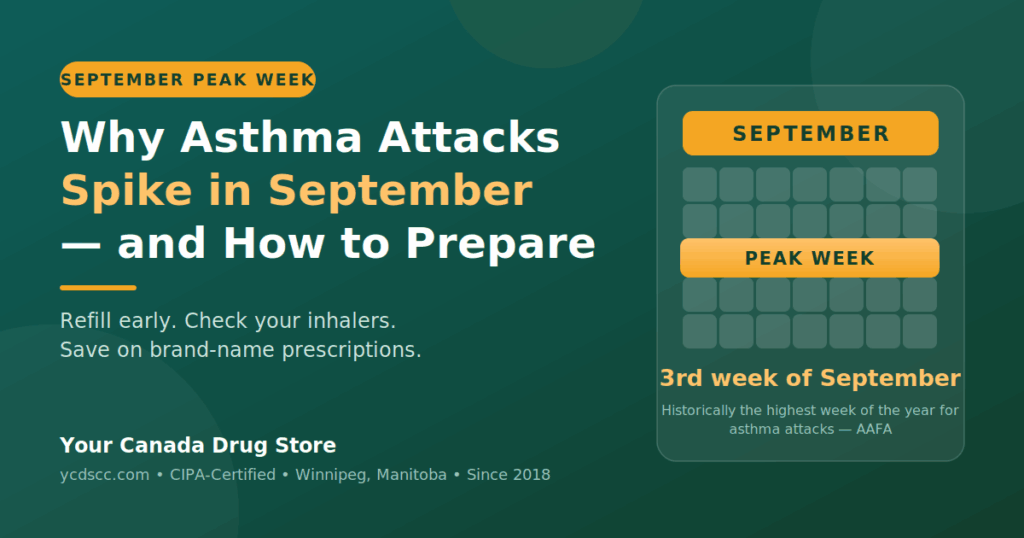
Quick Summary: Asthma attacks, emergency room visits, and hospital stays climb sharply every September, and the third week of the month — known as Asthma Peak Week — has historically been the worst week of the year. The Asthma and Allergy Foundation of America (AAFA) attributes the spike to children returning to school, spreading respiratory viruses, peak ragweed pollen, and rising mold counts. The best preparation is simple: make sure your controller and rescue inhalers are filled, in date, and on hand before mid-September. Your Canada Drug Store (YCDSCC), a CIPA-certified prescription referral service in Winnipeg, Manitoba, helps U.S. patients fill brand-name inhaler prescriptions at regulated Canadian prices.
What is Asthma Peak Week?
Asthma Peak Week is the third week of September, when asthma attacks and hospitalizations have historically reached their highest point of the entire year. The Asthma and Allergy Foundation of America calls September “Asthma Peak Month,” and researchers have described the annual surge as the “September asthma epidemic.” Roughly 28 million Americans live with asthma, and about one quarter of all asthma-related hospital stays for children occur in September alone. The pattern is so consistent that researchers can time it: asthma hospitalizations for school-age children peak roughly 18 days after Labor Day.
One important update for 2026: AAFA’s latest data analysis shows that asthma “peaks” can also occur at other times of year, particularly in winter when respiratory infections circulate most heavily, and the organization now refers to a broader “Asthma Peak Season.” September and October remain the critical window to take action, because that is when asthma attacks, ER visits, and hospital stays begin their climb — especially in children.
Why do asthma attacks spike in September?
Several triggers converge in the same few weeks. Children return to classrooms just as respiratory viruses begin circulating, and rhinovirus — the main cause of the common cold — is the infection most often linked to serious asthma attacks. Kids catch these viruses at school and bring them home to parents, siblings, and grandparents, which is why the September peak hits school-age children first, then preschoolers, then adults. At the same time, ragweed pollen, the most common fall allergen in the United States, reaches its highest levels in mid-September. Mold counts rise as fallen leaves collect and decay. Flu season begins. And many families have relaxed their asthma medication routines over the summer, which means airways are less protected exactly when trigger exposure is highest.
How can I prepare for Asthma Peak Week?
Preparation matters more than any single trigger. Here is a practical checklist to work through in early September, ideally with your doctor:
- Refill your controller (maintenance) inhaler now. Daily controller medications only protect airways when taken consistently. If summer routines slipped, restarting before mid-September gives the medication time to work.
- Check your rescue inhaler’s expiry date and dose counter. An expired or nearly empty rescue inhaler discovered during an attack is a genuine emergency. Replace it before you need it.
- Review your asthma action plan. If you or your child do not have a written action plan, September is the time to ask your doctor for one. Schools typically require a copy for students who carry inhalers.
- Get vaccinated. Annual flu vaccination is recommended for people with asthma, and September timing covers the season ahead.
- Reduce trigger exposure. Track local ragweed pollen counts, keep windows closed on high-pollen days, and encourage regular handwashing once school starts.
- Order refills with shipping time in mind. If you fill prescriptions through a Canadian pharmacy service, order in the first week of September so your medication arrives before Peak Week.
Why are asthma inhalers so expensive in the United States?
Inhalers are a textbook example of the U.S. brand-name pricing problem. Most modern inhalers combine a decades-old medication with a patented delivery device, and manufacturers have used successive device and formulation patents to delay generic competition for years. The result is that U.S. patients have routinely paid several times more than patients in other countries for the same product, made by the same manufacturer. A 2021 RAND Corporation analysis found U.S. brand-name drug prices overall average more than four times those in 33 comparable countries, and inhalers have been one of the most cited examples — the disparity was stark enough to prompt a U.S. Senate committee investigation into inhaler pricing in 2024.
Didn’t manufacturers cap inhaler prices at $35?
Partly, and the details matter. Following the Senate investigation, several major inhaler manufacturers — including GSK, AstraZeneca, and Boehringer Ingelheim — announced $35 monthly out-of-pocket caps on many of their inhalers in 2024. These caps are genuinely helpful for eligible patients, and if you qualify, you should use them. But the caps are savings programs, not price cuts: underlying list prices remain high, eligibility rules apply, not every inhaler is included, and patients with government insurance such as Medicare or Medicaid are generally excluded from manufacturer copay programs by federal rules. Many patients — especially seniors on fixed incomes with Medicare Part D — still face substantial out-of-pocket inhaler costs.
How much can I save on inhalers from Canada?
Canada regulates patented medicine prices through the federal Patented Medicine Prices Review Board (PMPRB), so brand-name inhalers sold in Canada carry regulated prices that are typically a fraction of U.S. retail. Commonly ordered brand-name respiratory medications at YCDSCC include Trelegy Ellipta, Breo Ellipta, and Advair Diskus (GSK), Symbicort (AstraZeneca), Spiriva and Spiriva Respimat (Boehringer Ingelheim), and Ventolin. Price-comparison analyses of licensed Canadian pharmacy services have found savings of roughly 50% to 80% on many brand-name medications.
| Inhaler | Typical U.S. Retail* | YCDSCC Price | Savings |
|---|---|---|---|
| Trelegy Ellipta | $28.16 per dose | $2.78 per dose | 90% |
| Advair Diskus | $5.25 per dose | $0.50 per dose | 90% |
| Flovent Inhaler | $2.12 per dose | $0.18 per dose | 92% |
| Anoro Ellipta | $9.22 per dose | $3.00 per dose | 67% |
*U.S. retail estimates based on [source] as of [month/year]. Prices subject to change.
Because asthma medications are long-term maintenance prescriptions refilled month after month, even a moderate per-inhaler saving compounds into significant money over a year of treatment. For a full explanation of why Canadian prices are lower, see our guide: Why Are Prescription Drugs Cheaper in Canada?
Is it safe to order inhalers from a Canadian pharmacy service?
It is safe when the service is properly certified. Look for membership in the Canadian International Pharmacy Association (CIPA), which requires a valid prescription for every order, patient privacy protection, and dispensing only through licensed pharmacies. Your Canada Drug Store is CIPA-certified and has operated from Winnipeg, Manitoba since 2018, working with licensed pharmacy partners under Health Canada’s regulatory framework. Inhalers dispensed in Canada are approved by Health Canada and are frequently made by the same manufacturers that supply the U.S. market. For more detail, see our Safety & Verification page and our guide, Is It Safe to Order Prescription Drugs from Canada?
How do I order my inhaler through YCDSCC before Peak Week?
Ordering takes three steps, and early September is the right time to start. First, get a valid prescription from your doctor — this is also a good moment to review your asthma action plan for the fall. Second, create an account at ycdscc.com and submit your prescription through our Upload Rx page, or send it by fax at 1-833-495-5107. Third, place your order online or by phone at 1-844-416-4282, and your medication ships directly to your U.S. address. Our Winnipeg-based customer care team is available Monday to Friday, 7:00 AM – 6:00 PM CST, and Saturday, 9:00 AM – 5:00 PM CST. Orders over $100 within North America ship free.
One important note: ordering from Canada is for planned refills, not emergencies. If you are having an asthma attack or your rescue inhaler is empty and you need medication today, contact your doctor or a local pharmacy immediately — and if you are struggling to breathe, seek emergency care.
Sources
- Asthma and Allergy Foundation of America (AAFA), September Asthma Peak and 2026 Asthma Capitals Report — aafa.org
- RAND Corporation, International Prescription Drug Price Comparisons — rand.org
- Patented Medicine Prices Review Board (PMPRB) — canada.ca
- Canadian International Pharmacy Association (CIPA) — cipa.com
This article is for general information only and is not medical advice. Asthma treatment decisions, including any changes to your medications, should always be made with your doctor. If you are experiencing severe breathing difficulty, seek emergency medical care immediately.